David Alexander Campbell



Research Interests:

Statistics for Dynamic Systems (Differential Equation) Models

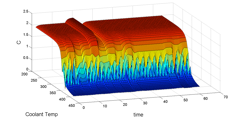
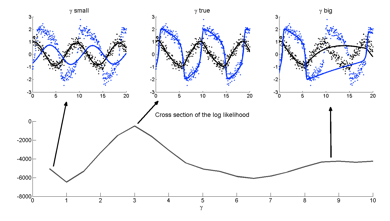
A single nonlinear differential equation (DE) model can describe a wide variety of behaviours including oscillations, steady states and exponential growth and decay, with relatively few parameters. Consequently, DE models are routinely used in describing chemical reaction dynamics, predator-prey interactions, heat transfer, climate models, economic growth, epidemiological outbreaks and many other problems from a diverse range of disciplines. I'm most interested in DEs without an analytic solution. Unfortunately the flexibility of this class of model implies that a likelihood centered on the solution to the DE is full of local maxima, ridges, ripples, flat sections and other difficult topologies. These give rise to a host of statistical challenges that I have been researching from Bayesian and frequentist perspectives.


Ramsay, J. O., Hooker, G., Campbell, D., and Cao, J. (2007), "Parameter Estimation for Differential Equations:A Generalized Smoothing Approach (with Discussion)," Journal of the Royal Statistical Society Series B, 69, 741-796.


Campbell, D., Hooker, G., McAuley, K. (in review), "Parameter Estimation in Differential Equation Models With Constrained Variables"


Computational Bayesian Methods


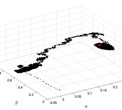
I am working on Bayesian sampling methods aimed at overcoming the unique challenges of dynamic system models. Often posterior densities for differential equation models have multiple modes and deep posterior valleys, sometimes thousands of units deep on the log scale. I am working on methods that can bypass these prohibitive topologies and produce a reasonable sample from the target posterior.


Campbell, D., Steele, R. (in review), "Smooth Functional Tempering with Application to Nonlinear Differential Equation Models"


Functional Data Analysis


I'm interested in functional data problems where the functions are 2 dimensional surfaces. Really I'm interested in spatio-temporal statistics but I'm coming from a functional data perspective.


Smoothing


Much of my initial interest in statistics came from learning about smoothing methods. I have worked with kernel regression and other local polynomials, and basis functions like wavelets, splines and Fourier.


Time-Frequency Analysis


My interest in time-frequency analysis grew from my research into Wavelets and Fourier analysis. I am interested in adaptive estimation of the instantaneous frequency of a signal. Having precision in estimating the time of an event happens in exchange for precision in estimating the frequency of an event. Avoiding this time frequency trade-off through Wigner distributions introduces other complications. I'm interested in adaptively choosing the appropriate time-frequency trade-off to estimate the time-resolved frequency features of a signal. My main collaborator for this project is Sean Hutchins who has a lot of interesting vocal recording data.


Hutchins, Sean and Campbell, David (2009), "Estimating the Time to Reach a Target Frequency in Singing" Annals of the New York Academy of Sciences, Volume 1169, Number 1, July 2009 , pp. 116-120


News:

Fall 2009 I am teaching Stat 203-3 in Surrey, Tuesday 11:30-1:30 and Thursday 11:30-12:30 in room SUR 5280.


Workshop on Statistical Methods for Dynamic System Models was a sold out meeting being held in downtown Vancouver June 4-6 2009, immediately after the Statistical Society of Canada meeting.


In May 2009 I taught Stat 890: Statistics for Dynamic System Models. This course was open to graduate students majoring in Statistics and Applied Mathematics.

Photos (Top down)

  1. 1.top left: The FitzHugh-Nagumo likelihood surface and fit corresponding to the modes, figure by Dave Campbell

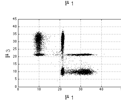
  2. 2.top right: Examples of dynamic systems and the 3-D path taken by an MCMC sampler, figure by Dave Campbell

  3. 3.upper left: Canoeing with my napping one year old (Summer 2008), photo by Tara Campbell

  4. 4.upper right: On an amusement park ride with my joyful four year old (spring 2008), photo by Tara Campbell